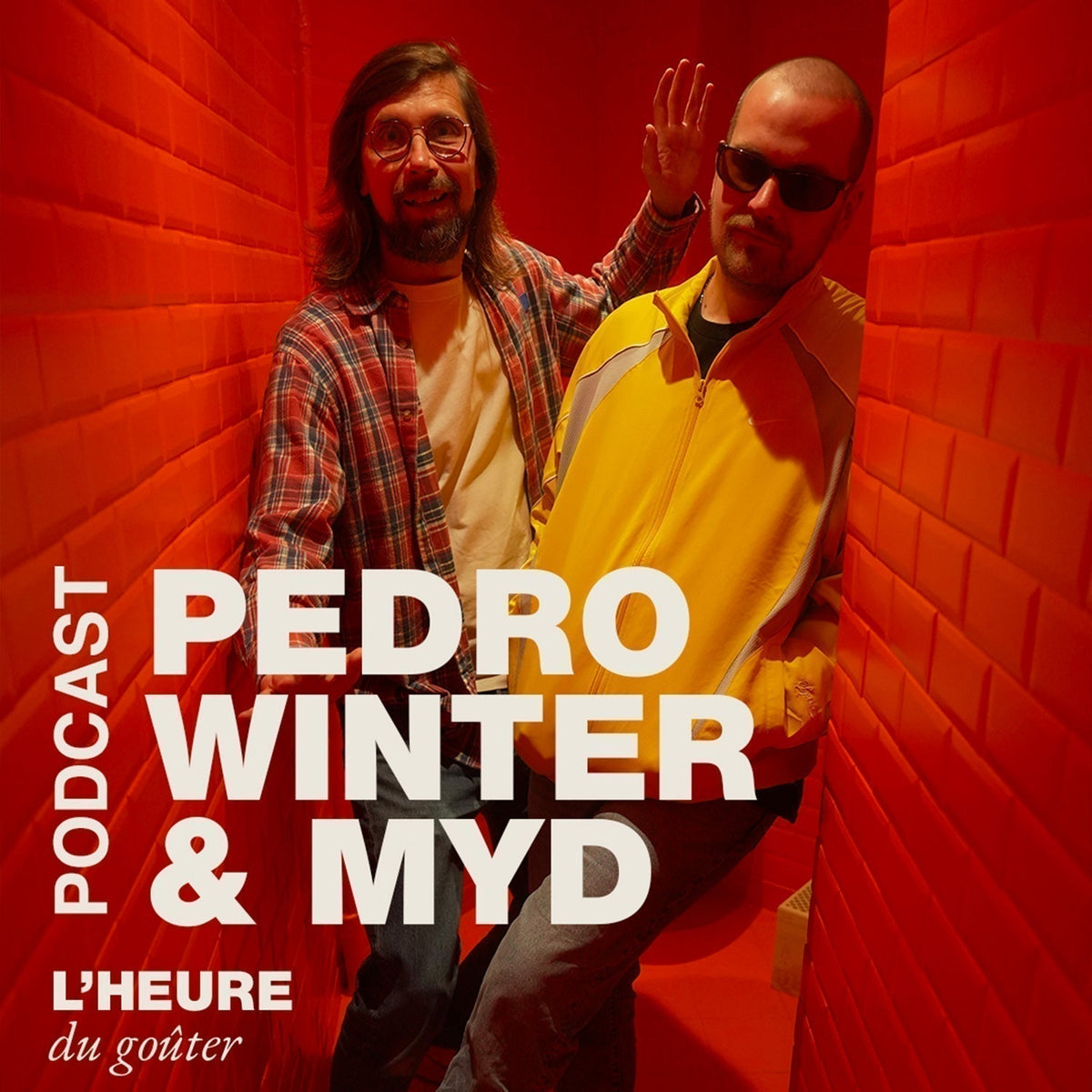
Pedro Winter came to À la Mère de Famille for a snack with Myd.
In this very first episode of the À la Mère de Famille podcast, Déborah and Steve welcome Pedro Winter and Myd for a snack. Between tasting and chatting freely (with their mouths full), juicy anecdotes and a look back at their collaboration and friendship, share this moment full of laughter and sweetness with us. You'll even find out whether Pedro or Myd is a fan of... rice cookers!

Thank you @pedrowinter @myd!
Enjoy listening 🎧
Listen on Spotify, Apple Podcasts, Deezer and Amazon Music
Pedro Winter
For him, it's all about pancakes. Not the ones we enjoy in January, but rather the ones we devour all year round. His pancake isn't eaten, it's listened to—it's vinyl. Pedro Winter has been making the world dance for three decades now. In 2003, he founded the Ed Banger Records label, specializing in electronic music, and championed iconic acts like Daft Punk, Justice, Cassius, and Mr. Oizo. In 2017, he welcomed Myd, the new spearhead of the French sound, into his band. Whether alone or accompanied, the artist-manager-label boss continues to tour the world's stages. And never forget to have a little snack.
Myd
Myd is the gem of French electro that shines all over the world. Not just because he only wears yellow. But especially because he offers music that radiates sunshine. In 2017, he joined the Ed Banger stable. His second album, MYDNIGHT, was released on August 29, allowing us to make the summer last a little longer.
Transcript
Déborah Pham — We're gathered today to record this first episode of L’Heure du Goûter, above the À la Mère de Famille shop on rue du Faubourg-Montmartre. Hello Steve!
Steve Dolfi — Hello Déborah!
Déborah Pham — Can you tell us who our guests are today?
Steve Dolfi Dolfi — Today, we're lucky enough to welcome Pedro Winter, founder of the Ed Banger label, and Myd, one of his latest protégés. We're delighted to have you here today, thank you for coming.
Pedro Winter — First of all, thank you for having us. We're also celebrating — as I was announcing to Quentin — the fact that he's part of this sublime list of chevaliers des Arts et des Lettres nominated by the Minister of Culture, following his involvement in the closing ceremony of the Olympic Games. They celebrated all the artists who participated. The list is quite sexy, to tell you the truth: there's Air, Phoenix, Lucky Love... Philippe Katerine, everyone. It's great. So you have a chevalier at your table!
Déborah Pham — We really pulled out all the stops! That's how you say it, isn't it?
Pedro Winter — You can say the basket... We can find the little dishes in the baskets.
Myd — No, there's a bit of everything, honestly...
Déborah Pham — We're having a scene a bit like in Pinocchio, when they wait to be able to eat. We've been watching everything that's been unwrapped for fifteen minutes. And now, there's a countdown. So we can give the start: L’Heure du Goûter starts!
Pedro Winter — Steve and Déborah, congratulations on your boldness. Who has the idea of doing a podcast with their mouth full? Because, so that people understand the concept properly, we're still going to taste chocolate. So there will be a conversation, but we'll have our mouths full.
Steve Dolfi — We salute all our misophonic friends who will hate these mouth noises, but we're up for it.
Myd — Fetishists will be happy, misophonics will be unhappy... You can't please everyone.
Déborah Pham — You can't please everyone. Especially since Myd, apparently, has been starving since last night because he fasted... Oh really, you haven't eaten anything this morning?
Myd — No. I don't know, I wasn't in the mood... And I thought to myself: honestly, this is the opportunity.
Pedro Winter — Me, I messed up my breakfast, so I'm delighted to be here.
Déborah Pham — You messed up your breakfast with an açaí bowl that was a bit...
Pedro Winter — Completely failed! On the one hand, I didn't follow the recipe and, on the other hand, I didn't have the ingredients. Let me tell you that I got off to a bad start. So I'm delighted to be here, at À la Mère de Famille, and to finally be able to taste. Well, I already know quite a few of these little treats that are on the table...
Déborah Pham — Yes, there are a few common stories between À la Mère de Famille, Pedro and Ed Banger.
Steve Dolfi — It's a long-standing love story with Pedro.
Déborah Pham — That's true. Can we put a number on this love story? Or do you want us to maybe go to the entrance?
Pedro Winter — As you wish. No, we can talk about love first... Wait, we can talk about love and eat at the same time! By the way, I won't hesitate to pounce on a Palet Montmartre. Are they called that?
Steve Dolfi — They are Palet Montmartre. Very thin squares, with praline inside.
Pedro Winter — And they look like records, just as a little anecdote. Did I pounce on this box of records completely spontaneously? Yes, I admit it. But it's especially this almond-nougat side that...
Myd — Me, I'm going to go for...
Déborah Pham — Oh my, Louloutre! Oh yeah... a badger!
Myd — Little by little... But we also have the right or...?
Déborah Pham — Well, go ahead! I'm going to make room, Steve, I understood perfectly.
Pedro Winter — I have to admit that we are two gourmands let loose in a chocolate shop. On the one hand, we are well-behaved people, so there is this distance, this restraint that prevents us from taking millions of things. But indeed, Steve guided us through the classics of the house, then through some slightly more unusual things. Myd, for example, what did you ask for?
Déborah Pham — It's good to ask him at the moment he just put something in his mouth! There is a lot of solidarity between us. We really see everyone's rhythm: "OK, he puts something in his mouth... Myd, it's your turn!"
Pedro Winter — I was going to eat to get rid of the answer. Here Myd, you tell it!
Myd — It's funny because... Well, I'm choking on little hazelnuts. Are they hazelnuts?
Déborah Pham — They are roasted almonds, toasted, with praline. And what is that called?
Steve Dolfi — Chocobats.
Déborah Pham — Oh my, Chocobat...
Myd — Chocobat is the sweet version of breaded fish: easy to eat, delicious.
Pedro Winter — I have some at home, I love them.
Steve Dolfi — That should calm your açaí.
Pedro Winter — It already feels good, right now.
Myd — It's funny because, if I look for photos of Pedro on my phone, I have a lot of him eating. Naturally, when we're on tour or when we see each other in Paris, either we're here to work and we're going to eat somewhere to talk about it, or we're on tour and we discover countries, restaurants, we share plans. In fact, one of the best plans you can get from a DJ is restaurant plans.
Pedro Winter — And to follow up on that: me, I sign all my artists around a meal. Justice, everyone knows the famous raclette story. I met them at a raclette! I crashed a dinner because I love raclette, and that's where I met Xavier and Gaspard from Justice. We had eaten sausage-puree...
Myd — No! It was much less sexy than that. We ate a vegetarian wrap.
With Pedro, I'm going to tell you the story quickly. I'm at a point in my life where I just spent a year making music alone for the first time. Before, I had bands. Now, I'm lost: I no longer have a label, no longer have a band. I make a year of music and I say to myself: honestly, my ideal label, for this family side I wanted to find again in music, is Ed Banger.
I think it's the label that can understand what I do, that Pedro can understand my music, which is a mix of Californian pop and electronic music. And then this family side attracted me. And we already got along pretty well.
Pedro Winter — We had done a date together in Manila. Remember. Do you remember or not?
Myd — Yeah, we had eaten a lot of dried mango...
Déborah Pham — Are they always healthy plans between you?
Steve Dolfi — No, but they are mostly memories punctuated by food.
Myd — Oh but of course! On tour, it's a bit your root. When you feel bad, you go towards something that reassures you. You can drink a drink that reassures you...
In short, I'm going to see Pedro and I'm going to make him listen to The Sun, among others, and two other tracks.
Pedro Winter — The Sun.
Myd — I make him listen to The Sun. It was the first thing: I didn't even say hello, I played The Sun. And Pedro said a legendary phrase to me: "Oh really, but then, what label are you thinking of to release this?" It's a bit like going on a date with someone and they tell you: "Oh, but I might have a friend to introduce to you."
Knowing that he didn't introduce me to a friend either...
And then he said: "So, shall we eat?" We climbed the steps of Montmartre to a restaurant called Soul Kitchen.
Pedro Winter — Oh my, but you are too good! Does it no longer exist? That too, it was a family affair: a mother with her daughters. It was super good.
Steve Dolfi — We hope we will still exist a little bit...
Déborah Pham — Now, I feel like we’re compromising you. Vegetarian wrap, dried mango… Thank goodness there’s a sugar limit.
Myd — It’s true that, despite ourselves, there’s a bit of an athlete in the life of a DJ, because a large part of your life isn’t very healthy.
Anyway, a week later, Pedro called me back and said, “Let’s start the adventure. At least, let’s try to start.” That was in 2017.
Déborah Pham — Nice story. And you already saw Ed Banger as a family. Is that how you see artists, Pedro?
Pedro Winter — It’s not necessarily something we look for, but it’s something that happened quite naturally. Maybe the fact that I’m a little bit older than everyone else makes me a bit like the big brother of this joyful bunch.
And then there’s something quite inclusive about it. We come back to what we’re experiencing together: we’re real pleasure-seekers. We don’t overthink things too much. I’m not saying we’re idiots and don’t think about anything, but we’re more like hedonists. Pleasure is what motivates us, and that’s what we want to share.
When Myd knocked on the door, I think he immediately saw that he was welcome. At that time, Justice was playing at Bercy, in 2017. I told Xavier and Gaspard, “Hey, Myd just joined the family, it would be cool to have him as an opening act.”
Déborah Pham — You say “the family”…
Pedro Winter — Yes. And he just arrives in the middle of us all, Breakbot, Irfane, people who have known each other for ten or fifteen years. I’m a bit the glue that holds everyone together, and very quickly, I realize that he doesn’t need me. He goes on tour with Breakbot and Irfane, he gets along very well with Gaspard, with So Me… It happened very spontaneously, very naturally.
Déborah Pham — A summer camp, a little?
Myd — Yeah, a summer camp. But it also confirmed something to me about life.
We often have this fantasy that the more you grow up, the older you get, the more your fame increases — regardless of your field — the more people you will have around you. For an artist, for example, you fantasize about the record label: an office you walk into, a guy with a cigar, gold records on the wall…
And finally, with most artists who are comfortable in their ecosystem, you realize that it’s the opposite: you end up reducing the number of people around you to keep those who inspire you, those you know well, and those with whom you share values.
We, for example, have common values. Pleasure is one of them: putting pleasure before other things that could be…
Déborah Pham — Money?
Myd — Yeah. Success…
Pedro Winter — I don’t care about being number one. What interests me is pleasure.
The label is over twenty years old now and, personally, I’ve been in the professional world for thirty years. I used to have my parties in 1995, right across from this shop, at the Palace.
Déborah Pham — Steve, did you know it a little?
Steve Dolfi — The Palace, yes. I lived through the Palace’s last years. It’s funny: the street of Faubourg-Montmartre, in the end, has always been like that.
Pedro Winter — We walked it! First as clubbers, with the Palace, the Privilège, the little club downstairs, that whole neighborhood. I used to have my parties back when David and Cathy Guetta had taken over the Palace, in the 90s.
Déborah Pham — Myd is handing out Louloutres to the production while you’re talking, I love it!
Pedro Winter — He’s sharing, it’s nice.
Déborah Pham — He’s great!
Pedro Winter — This neighborhood, in my adolescence, had become a nightlife neighborhood, but I first knew it by day since my mother worked on Rue Bergère and I lived at the bottom of Rue des Martyrs, in the 9th.
I have a very precise memory of this place, of chocolate and marshmallow, when I used to go see my mother work. I would go across the street, to Fou Rire, to get costumes, gadgets, crap: the fake poop, the firecrackers, the farting cushion…
So it’s a street I walked by day and by night. And it’s funny: when Myd arrived here earlier — without revealing your address, even though everyone knows it since you were on television — he said that the shop was a bit the transition between Montmartre and Paris, the heart of Paris.
Myd — It’s true that it’s a bit the street of pleasure: you can dress up, eat chocolates, and then go to the club.
Steve Dolfi — What I find fascinating — and that’s why I thought of you immediately when we talked about transmission — is that with Ed Banger, you really have the impression that it’s a family.
It’s already the impression you have when you don’t know the people, but when you know them, you realize that there really is this family notion in the label you created. And I find that, moreover, the very principle of the label is really the definition of transmission. When Myd presents his track to you, you are the relay that will offer it to the rest of the world. I find it fantastic.
Pedro Winter — That’s it. Moreover, in “transmission,” I love the idea of transmission of waves, radio. The principle is there: to be a kind of loudspeaker for artists and for a French musical culture, rather electronic, all these years.
That’s what motivates me, interests me, and excites me. And that’s also what makes us still present after all these years, in a field where cycles and trends go very fast.
When Myd arrived at Ed Banger, it also allowed us to project ourselves into the future, not to stay in a certain form of comfort, to renew ourselves, to challenge ourselves. And that still excites me just as much after all these years.
Déborah Pham — Who transmitted this love of music to you?
Pedro Winter — Unconsciously, I think it’s my older brother. He’s four years older than me and, for all the people who have older brothers or older sisters, it’s a particular experience. He was a model: you want to listen to the same music, to go through the stages a little faster.
He made me listen to Pink Floyd and Led Zeppelin when I probably should have listened more to the music of the moment. Even if, at the time, I still listened to Run-DMC and current music. But you want to follow your older brother.
And the luck I had is that he had his ears wide open. One day, he was into New Wave, so he would take me to listen to The Cure, and the next day he was into something else…
Steve Dolfi — What’s crazy is that it was still a pretty rock culture, and you then moved on to electronic music.
Pedro Winter — I moved on to electronic music, but it wasn’t really a choice. It was more the fact of being in a place at a given time.
From the moment I started being able to make my own choices, this musical current arrived and we took it full on. Electronic music, I discovered it in the early 90s. It was still a music on the fringes, an alternative music that you had to go dig into, clear out to be able to listen to and see it.
But there were many of us, it was a movement. After, I became professional and that’s where I met Daft Punk and company. But before that, I was just a fifteen-year-old teenager…
When did you get into electronic music?
Myd — We have an age gap, but it’s true that time crushes perspectives. Now, electronic music is part of everyday life: it plays on the radio, most pop productions are electronic…
But even me, when I started discovering it around fifteen or sixteen, it wasn’t the cool music at high school.
Pedro Winter — For me, that’s exactly it. It was totally the uncool music.
Myd — In my time, what was cool was skateboarding, rock, punk-rock. And on the other hand, you had a bit the computer fans and the beginnings of the Internet. It was geek music.
By the way, one common point between many electronic musicians is that they were huge geeks before anything else.
Déborah Pham — Technicians, a little?
Myd — Obviously, because your tool is necessarily linked to technology. You have to read manuals, understand things. After, the software became more and more simple — or at least more accessible — but there is still this geek thing.
Déborah Pham — And the fact that all this is simplifying and becoming democratized, doesn’t it remove a bit of craftsmanship, in a certain way?
Myd — No, because we always think that a technology will remove craftsmanship or replace something, when in fact, it’s just one more tool. Whether we tell a story by writing it with a pen or by typing it on the computer, what matters is the story.
Pedro Winter — Excuse me, but since a while now, there’s Henri the Fish making eyes at me. I’m going to try something…
Déborah Pham — Delicate…
Pedro Winter — He’s so chic. I said to myself… Well you see, not so chic. Look!
Déborah Pham — Oh yeah! But you who love white chocolate, there, you’re good.
Myd — There, I’m served. There’s something quite excellent, if you don’t have the image: the fish is shiny like a fish that has just been caught. It’s a chocolate fish, obviously. And inside, there are a little of these little entrails, like when you gut a fish, except they are full of… Oh my god, a seahorse!
Pedro Winter — Oh my god, the little seahorses!
Déborah Pham — Very cute. Myd, what’s your guilty pleasure?
Myd — There isn’t really something I couldn’t live without in terms of food. I can have moments where, as I was telling you coming in, I can completely forget to eat.
Steve Dolfi — That, that amazes me.
Myd — I can love a great restaurant and, when I go to a restaurant, I like it to be really delicious. But there are also moments where I can be quite ascetic. For example, I love rice. That could be my guilty pleasure.
I love rice from a rice cooker and I have a high-quality rice cooker.
Steve Dolfi — Wait, I want the reference, I’m interested.
Myd — Zojirushi. It’s a Japanese brand that DJ Falcon recommended to me and it makes the best rice you have ever eaten. It really makes a difference.
Déborah Pham — So you cook! You’re still picky!
Pedro Winter — Wait Déborah Pham, he just said, “I make rice in a rice cooker” and you tell him he cooks. I tell you that I mess up my açaí bowl and you ask me if I’m a great cook?
Déborah Pham — Yes, because it’s technical, the rice cooker brand…
Myd — When I talk about “pleasure-seekers,” that’s it. The pleasure will be in the fact of putting the sliders to the maximum on the things we love.
We want chocolate? Well, we’re going to come to the best chocolate shop. I love rice? I want the best rice cooker to have the best rice.
It’s a bit the thing of DJ Falcon too: he, he decided to put his life at the service of pleasure.
Pedro Winter — Yeah, it’s true that’s it.
Myd — Pedro, if he installs a sound system in his office, it will be the best sound system. We go into very technical things, very precise.
Steve Dolfi — The principle of a sound system is that it cannot be excellent for everyone: it’s something that suits you. But this quest to go for the best chocolate, the best pressing… Is it something that was transmitted to you or something you developed?
Pedro Winter — My parents transmitted this desire to me. My parents separated, so I had different memories at my father’s and at my mother’s.
My father knew how to party, there were always people. And my mother, her job, was the party: she was in charge of public relations for RTL. Her job was to organize receptions after concerts, at the Book Fair or during cultural events for which RTL was a partner.
Me, I was little and I absorbed all that. I was at the opening of Bercy with Julien Clerc, I saw Johnny Hallyday twenty-seven times in concert, Michael Jackson at the Parc des Princes… But at the time, I was just a ten-year-old child following his mother.
Steve Dolfi — Do you do the same with your children or not?
Pedro Winter — They are still a little small, but it’s starting. I transmit things to them, but in the same way my parents did it with me: without it being dogmatic. It’s an ultra spontaneous and natural sharing. After, it’s up to each one to translate and keep what they want.
It took me a very long time to understand that it was finally all that my parents had transmitted to me that gave birth in me this desire to be behind the scenes, behind the artists.
At the beginning, I wanted to be a lawyer. I remember that I even wanted to be an artist’s lawyer, while I had no idea what that meant!
But I quickly forged the link between what my parents had passed on to me and my desire to be alongside artists, behind the scenes, creating the show or at least offering something. That is something they really passed on to me.
Myd — Personally, I don't think it came from my parents.
Pedro Winter — Your father wasn't a musician?
Myd — Yes, he was. A love of music, yes. But if we're talking about this thing of enjoyment, of pushing the boundaries... I think I discovered it quite late.
I started developing very specific tastes when I discovered electronic music, especially through the internet. At the time, the only way to find more was to come across people who were very specialized in their field, who knew a style of music or an artist very well.
It was reflected in the way of digging for music on the internet. There were no computer-generated playlists yet, specifically designed for you. Today, you discover a lot of music because you are given music that you are supposed to like.
Steve Dolfi — Which I think is pretty catastrophic.
Myd — That's just the beginning! And it's interesting in relation to the theme of transmission.
At the time, I had two ways of discovering music. A friend would play me an album, I would like it, then I would go on the internet. There was peer-to-peer software that allowed you, in a way, to go and see someone else's discography on their hard drive.
Steve Dolfi — We remember...
Myd — And it was fascinating because you were discovering the discography of someone who had organized it in a certain way, who had highlighted certain tracks and decided not to include certain albums. You were discovering music through their very specific tastes.
And when I started wanting to become a DJ, I would go to a record store. I think I was fifteen, and I would buy one record a week. I would mix it with the one I had bought the previous week.
When you are fifteen and you want to buy a record, you go to the seller and you tell him: "I discovered Fatboy Slim or Chemical Brothers." And he answers you: "Oh yes, that, that is called this style of music. In this style, there is this new thing that just came out..."
And he plays you some things.
True story: I buy the Justice record.
Pedro Winter — The first album?
Myd — No, Never Be Alone.
Pedro Winter — Oh yeah, okay.
Myd — Justice's first single, without knowing what it was.
Pedro Winter — What did you buy it for? For the cover?
Myd — No, by listening to it. The seller played it for me and I thought it was crazy. And above all, at the time, I was taking things that were easy to mix together because I was a really bad DJ. I was a complete beginner.
The beginning of Never Be Alone was just "tin tin tin tin..." and I thought: "Oh yeah, so cool, it's great!"
Déborah Pham — Myd, what is the best advice Pedro ever gave you?
Myd — There are two. But the real strategic advice I keep, and that I have myself passed on to others since, is that hits last and the rest, we forget.
It is very important in the choices we make, because you must not be afraid to do things. Anyway, what didn't work, a few months later, we had forgotten about it.
Déborah Pham — Fear of failure?
Myd — Not exactly. It is more about asking yourself: "Am I doing this, even if it might flop?" Today, I feel like the attention span is dropping even more, and for that, it is almost a good thing: what was not a success fades and disappears.
Steve Dolfi — It allows you to have less pressure when you make a new album after the previous one was a huge success.
Myd — Yes. And especially for slightly weird side projects. You can start asking yourself: "Does this really fit...?" and overthink it.
Pedro, he will be the first to tell me: "No, but it's simple: do you want to do it, yes or no? If yes, go ahead, do it. And at worst, it flops and then we don't care."
Steve Dolfi — Do we remember that Quincy Jones made a track for Zaz, for example?
Pedro Winter — Oh my god, the files! Is that story true? Wait, did he really do it or not? In any case, yes, he really looked into his file, which was pretty unreal.
Myd — And so that was a great piece of advice.
Pedro Winter — Wait, no, there is another thing I whispered to you.
Myd — That's true. When I went to see him with The Sun, it wasn't called The Sun. But the lyrics already said "The Sun".
I had just come out of a period in a band where we were overthinking the names of the tracks: "Yeah, but it shouldn't be too obvious..." And Pedro told me: "Well no, your track, it has to be called The Sun."
Déborah Pham — What was it called?
Pedro Winter — I don't know. Certainly a shitty name.
Myd — Actually, it had no name. The demo was called Manchester.
Pedro Winter — Great!
Déborah Pham — It is true that it is beautiful there!
Pedro Winter — Whereas today, The Sun, for real, on one hand the track is fabulous and great, but it is also one of the biggest hits of the label in terms of streams. I don't remember anymore, we are platinum disc...
Myd — It is the best track of the label, we can say that!
Pedro Winter — There are tracks like that. Today, it is on the same level as Baby I’m Yours, D.A.N.C.E. or I Love You So, which have become well-known tracks of the label.
When I heard The Sun, I fell in love with the track immediately. But I never had the pretension of listening to something and saying: "That, that will be a hit." And today, The Sun has really become a little hit.
Myd — It is quite funny: we never say "it's a hit". We never have those discussions with Pedro. We ask ourselves: "Do we think it's cool? Do we like it? Does it move us? Do we think it's good?"
Déborah Pham — But when you hear it for the first time, you don't have a flash of insight like: "OK, this is going to blow up"?
Myd — No, no.
Pedro Winter — No.
Myd — That is where I am very bad! We had chosen another title, we had shot another music video. There is even a kind of Mandela effect: people think that the music video on the boat is the one for The Sun, but it was not the music video for The Sun. It was the one for All Inclusive, the other track we thought was stronger.
But that's how it is, and it's really cool.
All these little things — and there are hundreds of others — also bring us back to pleasure. Does what you do make you feel something? Do you think it's good? Without necessarily entering into a too complicated scheme or strategy.
That doesn't mean we do everything however we want. It is more that at some point, we don't know exactly what we are doing, but we know we are doing it well. And that is important.
Steve Dolfi — Because just like a chocolatier, I want to tell you: you sell emotion. At some point, if the emotion is real, that is the point, I think.
Myd — Of course. There are a thousand reasons not to do things. You can tell yourself: "A fish, it is too realistic, people will look at the fish and they will not think they want to eat chocolate." Or else you look at it and you say: "But it's amazing!" And that's it.
It is often like that when I talk with Pedro. I come to propose an idea to him and I tell him: "Pedro, I have an idea, I think it's amazing." And it can be: "Come on, we are going to make a music video on a cruise", "We are going to make a photo book in Dubai", "We are going to do a party somewhere..."
Déborah Pham — Pedro is a bit of a yes man like that when you propose crazy plans to him?
Myd — No, because he takes the time to think. And for me, it is extremely important to have his approval and his filter.
Pedro Winter — Personally, I am an enthusiast. And the chance to work with artists like Justice or Myd is that they bring a lot of proposals.
After, it is up to us to sort them out, to make sure it is possible and to put them in contact with the right people.
On a project like Myd, we really have a blast. There is a desire to reach people, but with a method that is at the opposite of what pop is today, where everything is calculated, controlled. There, we have fun, we please ourselves, we are demanding and we try things.
To announce that he was making a new record, Myd locked himself up for a week in his studio, live on Twitch. It was him who came up with this idea. For me, it is a field that is a bit foreign to me. But we followed it and helped him set it up because there was still quite a bit of organization and technical work.
And the result is really cool. It serves the Myd project and, at the same time, the fans of the label find it very coherent. Whereas, alone, I would never have had this idea.
It is in this sense that we bring things to each other. We were talking about transmission: what is great is that it is a two-way street.
Déborah Pham — What is the common thread? How would we describe an Ed Banger artist? What would be the common thread?
Pedro Winter — That is a good question. That is where my editorial shortcomings appear: I would like to find another word than "enjoyment"! Pleasure... "Hedonist", I like it because it is a pretty word and it translates the general spirit quite well.
Personally, I am the spokesperson and I am a little bit more expressive than Xavier or Gaspard, for example. If you talk to Xavier and Gaspard about Justice, you are not necessarily going to say: "Oh yeah, they are the biggest enjoyment seekers", because they are rather reserved. But yet, they really are enjoyment seekers.
Steve Dolfi — In my memory, Gaspard is a gourmet too.
Pedro Winter — Yes, of course! They are simply not the most expressive in interviews.
But what binds us all together, I think, is that we do all this for our pleasure. In a very selfish way, by the way: the personal pleasure of doing things. And at the same time, in hindsight, I feel like it is the most honest and most transparent method to then reach people.
As you were saying, there is a part of emotion. With music, we are very focused on dance, but I think that with Ed Banger and the artists of the label, we have made music that goes beyond dance.
I meet people in the street who tell me: "You rocked my adolescence, you accompanied me. Now I am a mom, now I am a dad." There is a real emotional bond. That is where we touch emotion.
So, to make a slightly shorter answer: what binds us all together, I think, is this real desire to have fun.
Déborah Pham — Yes, and you pass on a certain taste for partying. Do you still party together?
Steve Dolfi — Ah, that is a good question.
Pedro Winter — Wait, do you want me to talk about the party in Ibiza last summer, Quentin?
Steve Dolfi — I can't wait to hear the answer!
Pedro Winter — Wait, I don't know, I have to ask him if he really wants me to talk about the party in Ibiza last summer...
Déborah Pham — Oh! Wait, are there files?
Myd — There are obviously files. We party a hundred times a year! Our job is partying, not counting the "civilian" parties.
Déborah Pham — You are artisans of partying. But do you still have that thing together?
Pedro Winter — Oh yes, fortunately.
Déborah Pham — You are not going to the turbin saying: "Come on, let's play the top ten"?
Myd — The day we do that, I think we will have to change jobs, or at least stop and do something else.
There is still a pleasure in going to mix, in going to party. And "partying" does not necessarily mean getting drunk. It can simply be all together, having a great evening, laughing...
Pedro Winter — We are still lucky to often have Ed Banger parties where there are many of us. And that is also what I love about the label.
Because the lonely life of a DJ, honestly, is sad.
Déborah Pham — It is hard, huh.
Pedro Winter — You’re lucky because you always travel with a manager or someone. You never really go out on your own. But I feel a bit sorry for solo DJs. I do a few solo myself…
Myd — I’m not against it. I think that’s exactly where the best adventures happen.
Last week, for example, I was in Edinburgh. I went out to eat with the guy who was organizing the party…
Pedro Winter — Come on, admit it, you couldn’t understand a word of his accent!
Déborah Pham — The Scottish accent!
Myd — And there’s also this thing: if you tour with someone, like a tour manager, for example, you can very quickly start to rely on each other.
When you’re all alone, you really are the person: you’re the DJ of the party and, because you’re alone, people will take care of you. “Come, we’ll show you the best bar, the best restaurant, come have a drink before, after the party, come to the afterparty…” And things will happen.
Déborah Pham — You’re looked after, a little.
Myd — Yes. And especially if you’re a good customer…
Steve Dolfi — But don’t you have a bit of a comedown after all that? There’s still an incredible energy, lots of people you make dance, and then you go home. If you’re alone and you have no one to share it with, isn’t that a bit much to handle?
Myd — No, because I’m actually an introvert at heart. So I juggle between the two.
I put all those moments on tour into the joy of partying, which is my joy, and into the joy of music. From the moment I walk into a club, I’m excited. I’m happy. I want to play, to turn the music up really loud, to play the new tracks I’ve found, old stuff…
And at the same time, I love taking naps, I love being at home, I love eating a bowl of rice in bed. That’s the truth.
Pedro Winter — I’m thinking about my solo experience. Maybe I was traumatized by that Icelandic promoter who came to pick me up at the airport when I was playing a gig in Reykjavik that evening.
I didn’t know him. He takes me with him and, between the airport and the city, there’s the Blue Lagoon, the Icelandic hot baths. He takes me there.
I’m in the locker room and I say to him: “Yeah, but I don’t have a swimsuit…” And then: “Oh no, no…”
I ended up naked with this promoter and we spent an hour in a bath! So, the Blue Lagoon is huge, right…
Afterwards, the evening went very normally and naturally. It had broken the ice! We had a really good evening, we went to a great restaurant.
But it’s true that this solitude can also push you to push yourself, to say: “Well, okay, different things happen to me.”
Myd — If you get into the right mood, anything is possible.
There are musicians who tell me: “Oh yeah, you’re going back there? You’re getting on a plane again?” Which I can understand. But it’s like everything in life: you can decide that everything sucks.
You can say: “Oh fuck, great, eating chocolate at eleven in the morning. Awesome…” Or you can say to yourself: “I’m going to play, I’m going to travel, meet people. I’m going to choose the music in a great club, in front of people who are excited to hear what I’m going to play. What more could I ask for?”
I’m not going to lie: after a lot of dates or a really big summer, you can be exhausted. You want to go home, sleep, be a little alone or with your family.
But maybe that’s also where this thing about pleasure comes from: your little pleasures become important.
Speaking of little pleasures, there’s always this mockery around DJ riders. The rider is the list you send before playing. There’s the technical list: “I want this turntable…” And then there’s the other list: what you want to eat, drink…
You, for example, Pedro?
Pedro Winter — Me, what do I ask for? Beer, vodka, coconut water… And at one point, we asked — Xavier and Gaspard put it on their rider — stamped postcards.
Déborah Pham — Oh, that’s funny!
Myd — That’s so cute.
Pedro Winter — Stamped postcards, so that when you arrive in a country, you can send them to your family right away.
And obviously, I ask for lots of candy, sugar-free chewing gum and chocolate.
Déborah Pham — What kind of chocolate is there?
Pedro Winter — I demand À la Mère de Famille! From now on, I’m announcing it to all the promoters in the world: I demand an À la Mère de Famille gift basket in my rider.
Steve Dolfi — You hope it won’t melt at Coachella?
Myd — I had heard that Snoop Dogg asked that everything be exactly 21 degrees from the moment he got off the plane until he arrived at the hotel and then in the dressing room.
There’s another DJ — I won’t mention his name — who wants a certain type of BMW to pick him up at the airport and take him to the hotel.
You could say that’s a star thing. But at some point, it’s also these little pleasures that keep you going. When you’re tired, when you miss your life, when you miss your family, when you’re uprooted…
Déborah Pham — It’s not necessarily being driven around in a limousine that will make you happy.
Myd — Maybe it is! That’s exactly what this little pleasure is.
Imagine, Pedro plays three dates in a row. He knows that when he arrives, he’ll have his little fresh coconut water. He had forgotten it would be there, he arrives, he sees it… And it puts him back in a mood. He’s reconnected with what he really loves.
It’s a comfort object, a little.
Pedro Winter — It’s totally a comfort object.
Déborah Pham — And so, what’s in your rider?
Myd — Mine is pretty classic: fruit, cheese and Perrier. Perrier is my little comfort object abroad.
I know that, when I have it, everywhere it tastes the same. It’s a kind of universal taste. Even Coca-Cola tastes different depending on the country, while Perrier, no.
Déborah Pham — You have a sharp palate!
Myd — The sugar in Coca-Cola is different depending on the country. For example, in the United States, you can ask for Mexican Coca-Cola in some places because it’s really better.
Pedro Winter — I told you I was going to come with a genius.
Steve Dolfi — I can’t wait to try your rice cooker.
Myd — And my little extra in the rider is a sports jersey from the local team.
Pedro Winter — Oh yeah, that’s true! That’s nice. You have a collection of football jerseys.
Myd — I really have a huge one now. It’s great. I have the Ibiza football jersey, a thing from Georgia… Since I ask for sports jerseys, sometimes there are some pretty funny things. In Canada, they gave me a hockey jersey. Now, I have a very, very good collection.
Déborah Pham — Not bad. So Myd, what’s happening on the work side?
Myd — I’m continuing the tour and I’m in the middle of a record release. Often, it takes a year or more, so it’s pretty excellent. I’m delighted. Releasing music makes me very happy. It’s really a birth.
Déborah Pham — What dates, what trips can you announce for us coming up?
Myd — I’m going to play in February at the Zénith de Paris.
Déborah Pham — Wow!
Myd — So I invite you. You’re both invited, by the way.
Déborah Pham — That’s so nice, thank you!
Myd — You can put little chocolates in the dressing rooms to please me.
Déborah Pham — Don’t you have a date in Japan? Because Steve and I, it’s a bit our…
Myd — I’m definitely going to have a date in Japan!
Déborah Pham — You can ask for Pocari Sweat in the dressing room.
Myd — It’ll be done.
Steve Dolfi — The Japan football jersey is pretty good.
Myd — There! So Japan… What else can I tell you? The collaboration with A.P.C., which is always on sale in all your favorite stores…
Déborah Pham — Maybe a chocolate record, Steve?
Myd — A chocolate record, as long as it’s yellow, that works for me. Is it possible to make yellow chocolate?
Steve Dolfi — Yes, we adapt. We can do anything. We even made a record for Breakbot.
Myd — Exactly! For the record cover? Excellent.
So yes, lots of things. Actually, as long as it’s around music, it makes me happy. I’m really happy.
And I may know what you forgot to say about the artists on the label: we are all, mainly or 100%, excited by music. There are few other things in our lives besides that.
Déborah Pham — That’s so great!
Steve Dolfi — Me, I first wanted to know what you wanted to convey to the world.
And then, precisely: what chocolate from here do you want to convey to the next guests?
Pedro Winter — The world is far too big and they are far too many… But in any case, to my children, my friends and the people I hang out with: kindness.
I think we need it. To consider the other. For us, our field is art, culture, music. Being a bridge between people, that’s what interests me, but with kindness.
So that, that’s my desire to transmit.
And what chocolate to transmit to the next guests? What can we leave them?
Myd — Something a little original… Maybe a piece of the fish?
Pedro Winter — There won’t be any left, let me tell you!
No, I like the idea of the Palet Montmartre. On one hand for its shape: I like this disc side. And then for the transmission, the passing on… Here, we’ll take this box and pass it on to the next guest.
Déborah Pham — Exactly. It’s maybe a disc, too.
Pedro Winter — It’s up to them to pass the next disc.
Déborah Pham — Well, thank you.
Pedro Winter — Thank you very much, it was great.
Déborah Pham — I hope you had a good snack. For us, it was pretty good for a first time!
Steve Dolfi — Me, I’m good!
Pedro Winter — Thank you Déborah, thank you Steve.
__
Every month, Déborah Pham, a journalist, and Steve Dolfi, co-owner of the oldest chocolate shop in Paris, receive inspiring guests for snack time, inside the secret dining room of the historic boutique. Personalities we want to listen to and make talk about transmission. Each guest arrives with a confidant, a person who matters, from whom they received an influence or to whom they transmitted a certain vision of the world. For an hour, we talk about bonds, memories, what is transmitted without even thinking about it. A conversation without filter and with a full mouth, since here we have the right.
Learn more